Throughout our time in South Korea we’ve seen lots of paper lanterns at the temples we visited. These lanterns are made to celebrate the Buddha’s birthday, and it’s the members of a temple, both the monks and the lay practitioners, who make these lanterns each year. After about three weeks of preparing, the birthday celebration culminates with the Lotus Lantern Festival, a nighttime parade on May 11th.

We stayed at a hotel across the street from the Jogyesa temple, which has a big role in the festival. When we first arrived in Seoul we went to the temple and saw many Koreans making lanterns. We were intrigued but didn’t think we’d be able to participate. So we took pictures of all the lanterns at the temple. This is one of our favorite photos. There was a 50 foot tall tree in the center of the courtyard whose branches had been decorated with lanterns. And there was a “roof” of lanterns about 20 feet tall that went around the tree. This roof hid the upper branches of the tree except in a few spots in the temple complex like this one.

The Bonguensa temple had large lanterns on display. Pictured here at the main gate are the four heavenly kings who are often called guardians. They have vowed to protect the temple from all evil, including our own evil thoughts. It’s common to see people bow to the guardians as they enter the through the main gate, as a way of acknowledging our own limitations of greed, hatred and delusion, and our wish to be free of these limitations. It was interesting to see the guardians as lanterns, and we were curious what they would look like lit up at night.

During our hike with our friend Namhee (who we met on retreat in India) she shared with us that she would soon be making small lanterns with her meditation group. We asked if we might join, and she got permission from her teacher to include us. We felt so happy to be invited to join their special day of lantern making and meditation! When we arrived at the meditation center we immediately felt welcomed by the 20 regular practitioners gathered. After a snack we got to work cutting the paper and then attaching it to the wire lantern frames with rice paste. It was a lot of fun!

While the lanterns dried we had lunch together. Here we are affixing the Sanskrit om characters to the lanterns. Pete opted for tweezers while Kristina got her fingers sticky with more rice paste. Throughout the day there was a lovely feeling of teamwork and community.

These finished lanterns will be hung in at the meditation center and their lights will shine all year. Next year they will recycle the metal frames and make new lanterns.

This is the altar in the meditation center. Pete was enlisted to swap out the picture behind the Buddha and Bodhisattvas, and the altar was cleaned and redecorated with new pink and white paper lotus flowers. Then Namhee’s teacher gave a brief lecture on meditation and Namhee kindly translated for us. The teacher emphasized the three-dimensional triangle shape of the meditator, with knees and pelvis forming the base and connecting to the earth, and head forming the apex and connecting to the sky. Then we meditated together for about 90 minutes, which was physically challenging for us because it was twice as long as we usually sit. We were very grateful for the opportunity to be part of this special community for a day!

The festival wasn’t called Lotus Lantern until 2008, when it was broadened from Buddha’s birthday celebration to be more inclusive of Korea’s folk traditions. More people started attending, including foreigners who heard about the beauty of the festival. This is Cheonggyecheon, a stream that was paved over in the late 1960’s and then restored in 2003. It’s a very successful urban renewal project that we enjoyed strolling around during the daytime. And it became magical at night, with the lights of the lanterns reflecting on the water!


There are three-day workshops offered in large lantern making. We could see why these would be popular, as these lanterns are gorgeous works of art and look like they would be complicated to make.

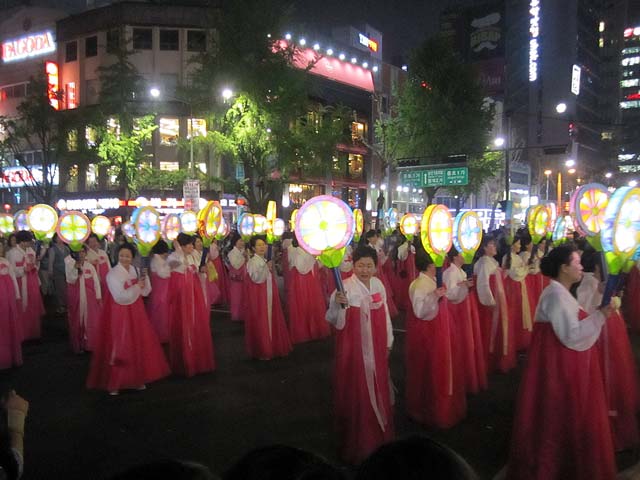
The Lotus Lantern Festival starts with a parade that includes lantern floats, musicians, and temple groups dressed in traditional costumes carrying lanterns. The atmosphere is high energy but friendly, with participants and spectators smiling and shouting greetings to each other.
Monks also march in the parade carrying lanterns and waving. The monks got the most cheers from the crowd.

On this float the baby Buddha looks like he’s striking the Saturday Night Fever dance pose but instead he's pointing to the heavens and flashing #1 sign. The legend has it that when he was born, he took seven steps and then proclaimed that he alone was the world honored one. We like the interpretation that the baby Buddha was speaking of Buddha-nature, which is the immutable and eternal nature of all beings. That's the real #1!

The dragon had smoke coming out its mouth. The lights were spectacular!

The four guardians that we saw earlier at Bongeunsa were also in the evening's parade.

Towards the end of the parade Kristina was given this tiger lantern from someone in the parade. She loved getting to carry her own lantern for the remainder of the festival, and then gave it to a girl to take home.

After the parade was the post-parade dance party. The stage included dancers, singers and musicians. The crowd joined in dancing and singing, too.

Confetti was blown into the air and it looked incredible as it circled around our heads. This girl was enamored of the confetti and was catching pieces of it. We were impressed with the positive atmosphere throughout the parade and party – there was no drunkenness or throwing of trash. Instead people were genuinely happy and enjoying themselves, and we felt completely safe while being in the huge crowd.


Since we’ve enjoyed the food in South Korea so much, we’ll end our last post here with another favorite meal. This is grilled Spanish mackerel. It was served with grated radish and citrus zest. We ate it with rice, savoring the flavor of the moist and delicious fish. Accompanying the meal was a pitcher of makgeolli, which is a fermentation of boiled rice, wheat, and water with an alcohol content around 7%. This pitcher is flavored with fermented pomegranate.


Next we fly to Vietnam for a two week cycling tour along the coast. We feel very fortunate to have had the opportunity to spend the past three weeks in South Korea exploring this interesting, beautiful and friendly country.

We stayed at a hotel across the street from the Jogyesa temple, which has a big role in the festival. When we first arrived in Seoul we went to the temple and saw many Koreans making lanterns. We were intrigued but didn’t think we’d be able to participate. So we took pictures of all the lanterns at the temple. This is one of our favorite photos. There was a 50 foot tall tree in the center of the courtyard whose branches had been decorated with lanterns. And there was a “roof” of lanterns about 20 feet tall that went around the tree. This roof hid the upper branches of the tree except in a few spots in the temple complex like this one.
The Bonguensa temple had large lanterns on display. Pictured here at the main gate are the four heavenly kings who are often called guardians. They have vowed to protect the temple from all evil, including our own evil thoughts. It’s common to see people bow to the guardians as they enter the through the main gate, as a way of acknowledging our own limitations of greed, hatred and delusion, and our wish to be free of these limitations. It was interesting to see the guardians as lanterns, and we were curious what they would look like lit up at night.
During our hike with our friend Namhee (who we met on retreat in India) she shared with us that she would soon be making small lanterns with her meditation group. We asked if we might join, and she got permission from her teacher to include us. We felt so happy to be invited to join their special day of lantern making and meditation! When we arrived at the meditation center we immediately felt welcomed by the 20 regular practitioners gathered. After a snack we got to work cutting the paper and then attaching it to the wire lantern frames with rice paste. It was a lot of fun!
While the lanterns dried we had lunch together. Here we are affixing the Sanskrit om characters to the lanterns. Pete opted for tweezers while Kristina got her fingers sticky with more rice paste. Throughout the day there was a lovely feeling of teamwork and community.
These finished lanterns will be hung in at the meditation center and their lights will shine all year. Next year they will recycle the metal frames and make new lanterns.
This is the altar in the meditation center. Pete was enlisted to swap out the picture behind the Buddha and Bodhisattvas, and the altar was cleaned and redecorated with new pink and white paper lotus flowers. Then Namhee’s teacher gave a brief lecture on meditation and Namhee kindly translated for us. The teacher emphasized the three-dimensional triangle shape of the meditator, with knees and pelvis forming the base and connecting to the earth, and head forming the apex and connecting to the sky. Then we meditated together for about 90 minutes, which was physically challenging for us because it was twice as long as we usually sit. We were very grateful for the opportunity to be part of this special community for a day!
The festival wasn’t called Lotus Lantern until 2008, when it was broadened from Buddha’s birthday celebration to be more inclusive of Korea’s folk traditions. More people started attending, including foreigners who heard about the beauty of the festival. This is Cheonggyecheon, a stream that was paved over in the late 1960’s and then restored in 2003. It’s a very successful urban renewal project that we enjoyed strolling around during the daytime. And it became magical at night, with the lights of the lanterns reflecting on the water!
There are three-day workshops offered in large lantern making. We could see why these would be popular, as these lanterns are gorgeous works of art and look like they would be complicated to make.
The Lotus Lantern Festival starts with a parade that includes lantern floats, musicians, and temple groups dressed in traditional costumes carrying lanterns. The atmosphere is high energy but friendly, with participants and spectators smiling and shouting greetings to each other.
Monks also march in the parade carrying lanterns and waving. The monks got the most cheers from the crowd.
On this float the baby Buddha looks like he’s striking the Saturday Night Fever dance pose but instead he's pointing to the heavens and flashing #1 sign. The legend has it that when he was born, he took seven steps and then proclaimed that he alone was the world honored one. We like the interpretation that the baby Buddha was speaking of Buddha-nature, which is the immutable and eternal nature of all beings. That's the real #1!
The dragon had smoke coming out its mouth. The lights were spectacular!
The four guardians that we saw earlier at Bongeunsa were also in the evening's parade.
Towards the end of the parade Kristina was given this tiger lantern from someone in the parade. She loved getting to carry her own lantern for the remainder of the festival, and then gave it to a girl to take home.
After the parade was the post-parade dance party. The stage included dancers, singers and musicians. The crowd joined in dancing and singing, too.
Confetti was blown into the air and it looked incredible as it circled around our heads. This girl was enamored of the confetti and was catching pieces of it. We were impressed with the positive atmosphere throughout the parade and party – there was no drunkenness or throwing of trash. Instead people were genuinely happy and enjoying themselves, and we felt completely safe while being in the huge crowd.
Since we’ve enjoyed the food in South Korea so much, we’ll end our last post here with another favorite meal. This is grilled Spanish mackerel. It was served with grated radish and citrus zest. We ate it with rice, savoring the flavor of the moist and delicious fish. Accompanying the meal was a pitcher of makgeolli, which is a fermentation of boiled rice, wheat, and water with an alcohol content around 7%. This pitcher is flavored with fermented pomegranate.
Next we fly to Vietnam for a two week cycling tour along the coast. We feel very fortunate to have had the opportunity to spend the past three weeks in South Korea exploring this interesting, beautiful and friendly country.


