We came to Java, Indonesia because we wanted to see Borobudur, the large Buddhist temple in the world. Our first view of Borobudur was from a nearby hillside at sunrise. It was incredible to see it emerge from the fog.

Here is Borobudur from the east. It became a UNESCO World Heritage site in 1991. Built on a hill, the temple has a square base measuring 387 feet long and is 115 feet tall.

This view from the corner shows the step pyramid shape. Completed in 825, it took about 75 years to build. The temple's most recent renovations were finished in 1975.

Borobudur became very crowded by mid morning. Many of the Javanese visitors are fascinated by westerners. We were constantly asked if they could take our photo with them.


There are 432 niches in the first five levels of the temple. Each niche was created to shelter a Buddha statue. All the Buddha statues are seated in meditation. Originally there were 504 Buddha statues (but 43 are missing and 300 are damaged). The Buddhas have different hand positions (mudras) depending on which direction they face. These Buddhas are facing East and have the earth-touching mudra, bhumisparsa.

We found these Javanese Buddhas incredibly inspiring and beautiful. We experimented with photographing the ones that were not enclosed, and are happy to share our favorites.


We went to Borobudur early one morning to watch the sun rise. Mt Sumbing is in the distance.

The temple was built to enable circumambulation from bottom to top. This is a form of Buddhist pilgrimage called pradaksina.

There are 2,670 bas-relief carvings on the five lower levels, which are both narrative and decorative. We were surprised to learn they were carved in place.

Here are two narrative carvings with scenes from the Buddhas life. On the left is the Buddha at the moment of his enlightenment: He is sitting under the Bodhi tree and is surrounded by Boddhisattvas and Devis. The close up is the Buddha in the abhaya mudra, meaning "have courage."


There are stone reliefs of the Jataka stories here too, which are morality tales. This relief is of the Monkey King Jataka. The monkey king is shown in the upper right of the second carving.


The top 3 levels of Borobudur are circular with 72 bell shaped stupas, each with a Buddha statue inside. These levels are also meant to be circumambulated.

We were fortunate to enjoy a magnificent sunset. Here is a stupa in silhouette. We found Borobudur to be inspiring and beautiful!

Because of its close proximity to Borobudur, Yogyakarta is the most visited city in Java. Yogyakarta is called Jogja by the locals. We were amazed that horse drawn carriages are still used as taxis.

Also popular are bicycle rickshaws called becaks.


We arrived on the last day of Ramadan, the Muslim month of daytime fasting. After Ramadan, Indonesian Muslims celebrate Idul Fitri by visiting their families and friends, so everything closes for several days. This gave us plenty of time to check out Jogja and we saw some awesome graffiti.


We rented a scooter to get around.

Look at the arms on these figures - they are shadow puppets.

We visited a traditional puppet making workshop and learned they are made from buffalo rawhide for durability. This art form has existed for over 1,000 years.

The puppets are called wayang, which means shadow in Javanese. They are painted with bright colors, even though in a puppet show the audience is watching the shadows of the puppets.

We didn't see a puppet show here, but we learned they can last as long as 10 hours.

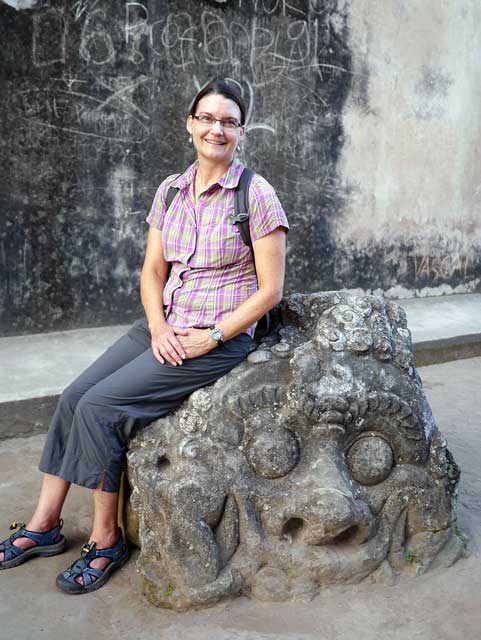
While exploring Jogja we happened upon the ruins of the Water Palace. We liked seeing how the old and the new coexist so easily in Java.
Here is Borobudur from the east. It became a UNESCO World Heritage site in 1991. Built on a hill, the temple has a square base measuring 387 feet long and is 115 feet tall.
This view from the corner shows the step pyramid shape. Completed in 825, it took about 75 years to build. The temple's most recent renovations were finished in 1975.
Borobudur became very crowded by mid morning. Many of the Javanese visitors are fascinated by westerners. We were constantly asked if they could take our photo with them.
There are 432 niches in the first five levels of the temple. Each niche was created to shelter a Buddha statue. All the Buddha statues are seated in meditation. Originally there were 504 Buddha statues (but 43 are missing and 300 are damaged). The Buddhas have different hand positions (mudras) depending on which direction they face. These Buddhas are facing East and have the earth-touching mudra, bhumisparsa.
We found these Javanese Buddhas incredibly inspiring and beautiful. We experimented with photographing the ones that were not enclosed, and are happy to share our favorites.
We went to Borobudur early one morning to watch the sun rise. Mt Sumbing is in the distance.
The temple was built to enable circumambulation from bottom to top. This is a form of Buddhist pilgrimage called pradaksina.
There are 2,670 bas-relief carvings on the five lower levels, which are both narrative and decorative. We were surprised to learn they were carved in place.
Here are two narrative carvings with scenes from the Buddhas life. On the left is the Buddha at the moment of his enlightenment: He is sitting under the Bodhi tree and is surrounded by Boddhisattvas and Devis. The close up is the Buddha in the abhaya mudra, meaning "have courage."
There are stone reliefs of the Jataka stories here too, which are morality tales. This relief is of the Monkey King Jataka. The monkey king is shown in the upper right of the second carving.
[If you want to know the whole tale, read on. Once upon a time, there was a tribe of 80,000 monkeys and their monkey king who lived in an enormous mango tree on the banks of the Ganges River. This tree had the most delicious mangoes. One day (human) King Brahmadatta was bathing in the Ganges, and a mango floated by. He tasted it and wanted more. He took his boats upstream in search of the perfect mango tree. Upon finding the tree swarming with monkeys, he ordered his hunters to kill the monkeys and harvest the fruit. The monkey king knew he had to act fast to save his tribe. He jumped across the Ganges, found a long vine, tied it to a big tree and jumped back to the mango tree. But the vine wasn't long enough to tie around the mango tree, so he tied it around his waist and used his body as an extension while holding onto a branch. He told all the monkeys to run across the vine to safety, and they did. Unfortunately, all the weight broke the monkey king's back, and he fell into the river as the last monkey ran across. King Brahmadatta had watched it all, and ordered the hunters to pull the monkey king from the river. The monkey king had just enough strength to confirm he had sacrificed his life to save his tribe, and to tell the King that it was his job to also put the lives of his people above his own. The King was so moved that he gave the monkey king a hero's burial, and from that day forth the King put his people first.]
The top 3 levels of Borobudur are circular with 72 bell shaped stupas, each with a Buddha statue inside. These levels are also meant to be circumambulated.
We were fortunate to enjoy a magnificent sunset. Here is a stupa in silhouette. We found Borobudur to be inspiring and beautiful!
Because of its close proximity to Borobudur, Yogyakarta is the most visited city in Java. Yogyakarta is called Jogja by the locals. We were amazed that horse drawn carriages are still used as taxis.
Also popular are bicycle rickshaws called becaks.
We arrived on the last day of Ramadan, the Muslim month of daytime fasting. After Ramadan, Indonesian Muslims celebrate Idul Fitri by visiting their families and friends, so everything closes for several days. This gave us plenty of time to check out Jogja and we saw some awesome graffiti.
We rented a scooter to get around.
Look at the arms on these figures - they are shadow puppets.
We visited a traditional puppet making workshop and learned they are made from buffalo rawhide for durability. This art form has existed for over 1,000 years.
The puppets are called wayang, which means shadow in Javanese. They are painted with bright colors, even though in a puppet show the audience is watching the shadows of the puppets.
We didn't see a puppet show here, but we learned they can last as long as 10 hours.
While exploring Jogja we happened upon the ruins of the Water Palace. We liked seeing how the old and the new coexist so easily in Java.


