Saturday, March 23, 2013

Kandy: Tales of the Tooth and the Tusker

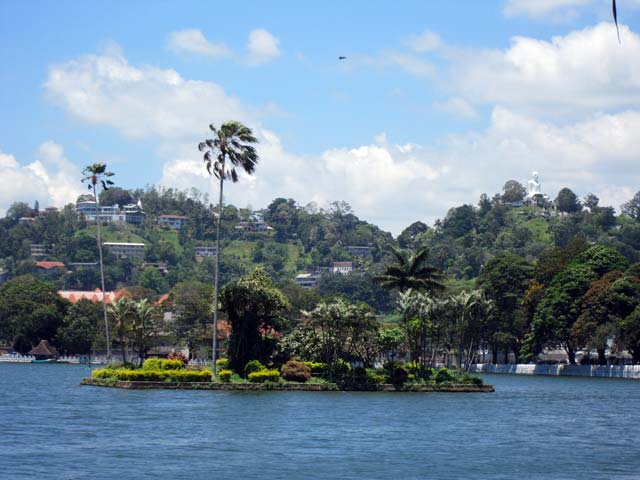
We flew from Bangkok to Sri Lanka, and started exploring the city of Kandy, which is the “cultural capital” of Sri Lanka. It’s beautiful and green here, more lush than Kerala but otherwise similar. Kandy was built around an artificial lake that was created in the early 19th century.


There several kinds of big trees lining the lake and at a nearby beautiful botanical garden, and we enjoyed strolling around. Pictured here are our favorite trees, the Pride of Burma has the red flowers and the Rain Tree was immense - this is a close up of one main bough.


Close by to the lake is the Temple of the Tooth,  the most important Buddhist shrine in Sri Lanka. The legend is that a tooth of the Buddha, after he had died and was cremated, was smuggled to Sri Lanka in the 3rd century, in the hair of a princess. It was taken to Sri Lanka, because the Buddha had said that Buddhism would be safe in Sri Lanka for 5,000 years. The tooth was first given to King Meghavarna and housed in Anaradhapura (the ancient capital of Sri Lanka, which we will also visit). Due to various power struggles over the years, the tooth has been housed all over the country. It ended up in Kandy at this temple in about 1687. Look for the gold roof - this is the Temple of the Tooth.


The Jataka tales are stories about the Buddha in his previous lives, before he was born as Siddartha Gautama and attained enlightenment. There are 50 of these Buddhist parables where the Buddha was born as different animals. One of the stories is about a starving monk who is saved by a hare who sacrifices his body to feed the monk. The hare is said to have “jumped into the moon”. The tale is captured on this Temple of the Tooth flag.


Over the years, safeguarding the tooth relic has been a responsibility of the Monarch, such that custodianship of the tooth came to symbolize the right to rule. The Temple of the Tooth was bombed on two occasions. Most recently and during the Sri Lankan civil war, the LTTE  (Tamil insurgents) detonated a bomb in 1998 and destroyed part of the temple, but not the tooth. There was huge public outrage at the bombing, not just from Buddhists. This is because the tooth symbolizes Sri Lankan sovereignty.


While researching the tooth relic of Sri Lanka in Wikipedia, we came to learn that four other counties also claim to have a tooth of the Buddha's: China, Japan, Taiwan and Singapore. As part of the 2600th anniversary of the Buddha’s birth in April of 2011, there was a beautiful gallery of Buddhas created at the Temple of the Tooth.


In the gallery are a series of paintings showing the history of the tooth. This is a close up of one of the paintings that shows the tooth well. The tooth is said to be the Buddha's left canine. Take a look at the tooth in the photo – it looks more like a tiger’s tooth than a human’s to us.


We attended a puja (offering) ceremony at the temple, and we were able to get a quick look at the casket that holds the tooth. There are 6 more nested caskets within the golden casket before you get to the tooth. No photographs are allowed of the casket, so here's a picture of the flower offerings.


King Meghavarna started a festival to honor the tooth called Perahera. The Perahera festival takes place in July or August each year. During the 11 day festival, the relic casket (without the tooth) is placed in a special case that is carried on an elephant’s back. The tusker (male elephant with tusks) that carries the relic is highly venerated.


We also learned on Wikipedia that Sri Lankan Asian male elephants generally do not have tusks. This fact makes the tuskers even more special. This is a picture of Raja the Tusker, the most highly venerated of all tuskers. He carried the tooth casket in the annual Perahera festival from 1950-1987. In 1986 he was named a national treasure. When he died at age 65 there was a national day of mourning. Raja was taxidermied and the Tusker Museum was created to display him.


And here’s a picture of Raja’s tooth. As you might imagine, the museum has some interesting displays!


This is a glass of avocado juice. There are lots of avocado trees in Sri Lanka, and the fruit is larger than the Hass variety we are used to. The fruit also has less fat. To make the juice, it’s slightly sweetened and thinned. It tastes delicious.

Monday, March 18, 2013

Bangkok: A Taste of Cosmopolitan Delights


We were happy to be in Bangkok while Pete's colleague Eric (right) and his partner Neil were too. They have been living the expatriate lifestyle and traveling throughout SE Asia since November, so they had lots of good suggestions for us. They took us to a hip skyscraper bar for cocktails where we enjoyed great views of the city.


Eric and Neil had tried most of the gourmet food courts found in the shopping malls, and were kind enough to tell us specifics like "don't miss the Thai dessert that looks like a taco - it's a crepe filled with coconut!"


One of the malls had a San Francisco theme, complete with a huge model of the Golden Gate Bridge. This photo is especially for Pat and Sarah, since their favorite butcher is in North Beach at Little City Meats.


We are lucky to be here during the start of mango season. We’ve seen 3 types of mangoes so far. We are doing our best to eat mangoes as often as we can! Besides the fresh fruit, we are enjoying mango smoothies, mango sorbet, mango infused tea and our favorite dessert, mango with sticky rice and coconut cream.


Bangkok is a contemporary city with easy-to-use public transit. There’s both an above ground Sky Train and underground metro, which are connected to the older modes of surface transport and canal boats. Here’s a picture of us on the platform of our local Sky Train station.


We enjoy getting comments on the blog and emails from friends and family. Our vegetarian friend Alice signed off her last email with "Eat something I wouldn't!"  This challenge was too easy because virtually everything we are eating (except the mangoes) has fish sauce or dried shrimps, even the salads. Here are two dishes we had for dinner which are a bit unusual: the greens are morning glory vines that have been stir fried, and the other dish is squid in a red curry sauce.


The food here has been outstanding! Our favorite Thai meal was at Nahm. Coincidentally Pete's parents sent us an email with a link to the NY Times Travel article on Bangkok, which featured this restaurant. The chef, David Thompson, (he is Australian by birth) won the James Beard award for his cookbook, Thai Food; We hope to get the cookbook when we have a kitchen again. At Nahm we did the tasting menu so we could try the Thai canapés, soup, salad, curry, relish, meat and dessert. The meal wowed us with the soft shelled crab salad and the persimmon in coconut crepes dessert with mangosteen fruit; Our waiter told us “mangosteen is the queen of fruit, and durian is the king”. 


We also were thrilled with Smith, a "nose to tail" restaurant that we heard about through a NY Times article about why people should go to Bangkok in 2013. (The chef, Ian Kittichai, was born in Bangkok, trained in London, and has had restaurants in NYC, Barcelona, Mumbai, Abu Dhabi, and Bangkok.) This is a picture of their head cheese; Since Pete has made head cheese, we always have to try it when we see it on a menu. Pete had pork belly as his entree, which was meaty and beautifully seared. Kristina had salmon that was lightly smoked and served with a lemon grass foam, which was exceptional.


We had a great time during our week in Bangkok! We even watched David O Russell’s latest movie, Silver Linings Playbook. Before a movie begins, the Thai national anthem is played and everyone stands for it. Next we fly to Sri Lanka for two weeks, a primarily Buddhist country that has lots of national parks.

Sunday, March 17, 2013

Bangkok: Exploring Monarchy and Buddhism

One of the first museums we went to in Bangkok was an interactive "discovery" type museum on the history of Thailand back to the Stone Age. Bangkok has been the capital of Thailand for over 200 years and there is a lot of wonderful history here that we've been exploring through visits to temples (which are called "wats") and to the Grand Palace. It's clear that the Thais love their King as there are images of him all throughout the city. The current King of Thailand, Rama IX, no longer lives at the Grand Palace and the place is crawling with tourists. We were struck by the interesting blend of architectural styles, culminating with the Thai roof that replaces the typical dome.


The most sacred of Buddhist temples in Bangkok is Wat Phra Kaew, Temple of the Emerald Buddha. Interestingly the Buddha is actually made of jade, and it has three different outfits which the King dresses the Buddha in; seen here is the winter outfit. It was over 100 degrees there when we visited, so we expect the winter robe isn't really necessary.


Nearby is Wat Pho, Temple of the Reclining Buddha. The over 150 foot long statue is truly impressive. 

 
Wat Pho was the first public university of Thai medicine, and is over 400 years old. This is a photo of Thai massage techniques which were painted on the exterior walls, which are still taught at this temple. We enjoyed two types of massages while we were here: one hour foot massage and two hour whole body massage. Thai massage is deliciously intense, where the masseuses put us into contortions (kind of like yoga poses) while using their whole body to deeply massage us.


The Wat Pho complex contains more than 1,000 Buddhas and counting, as wealthy Thais can pay to have one installed as a way of bringing merit to their family.


Across the river is Wat Arun, Temple of Dawn. It was the tallest building in Bangkok (over 250 ft high) until the advent of skyscrapers, and features extremely steep steps that are like climbing a ladder with 12 to 16 inch rungs. The exterior is decorated in with Chinese pottery shards, which we heard were ballast in Chinese ships that were traveling to Bangkok to buy rice.


We also visited Wat Traimit to see the 13,000 pound solid gold Buddha. It was created in the 13-14th century in Ayutthaya, the capital of Siam at the time. In the 18th century Ayutthaya was under siege by Burma, so it was covered in plaster and painted in disguise. When Bangkok became the capital, the statue was moved here, still covered in plaster. In 1955, an attempt to move it resulted in the ropes breaking and the statue falling, which cracked the plaster to reveal the golden Buddha.   


Spirit houses are commonly built in Thailand, as well as in Burma, Cambodia and Laos. When a new building is constructed, the spirit houses are built to appease the displaced spirits, as it is believed that they inhabit the land. Priests will often select the location of the miniature house, and it's important that the full size building does not cast a shadow on it. Offerings made regularly that include food, drink, incense, and flowers.
The above spirit house was from the Jim Thompson house. He was an American who was part of the OSS (precursor to the CIA) towards the end of WWII. While he was stationed in Thailand he grew to love the culture. After the war, he settled in Bangkok and built an amazing house that is modeled on Thai historical architecture. He furnished it with antiquities from Thailand and Burma. These views are of the garden (as we were not allowed to take pictures inside the house).


Sunday, March 10, 2013

Fort Kochi: Farewell to India

For our final cycling tour lunch, our guide and driver, Safi and Michael, bargained with fishermen for fresh fish and tiger prawns. We brought them to a restaurant that offers “you buy, we cook” services and enjoyed a delicious farewell lunch.


We are so appreciative that we can communicate in English while we’ve been in India. We’ve noticed some funny-to-us signs like restaurants offering “homely food”, and temples posting “eatables not allowed inside”. The phrases are technically accurate, but are idiomatically different than what we’d find in the US. Here’s what is written on fire extinguishers:


Throughout our travels in Kerala, we've noticed a number of communist images. We also saw thousands of signs for the Democratic Youth Federation of India as we cycled; they were painted on posts, walls and the on the pavement. We learned that DYFI is the largest youth organization in India and it's affiliated with the Communist Party of India (Marxist). According to our guide Safi, they use violent tactics to further their cause.


We were curious about the history of communism in Kerala, so we checked in Wikipedia. Here's an excerpt: Nine years after India gained independence from the British, the state of Kerala was formed. In 1957 elections were held and a reformist, Communist-led government came to power. It was the first time a Communist government had been democratically elected to power anywhere in the world. It initiated pioneering land reforms, leading to the lowest levels of rural poverty in India. The new government refused to nationalize the large estates but did provide reforms to protect manual laborers and farm workers, and invited capitalists to set up industry. Much more controversial was an effort to impose state control on private schools, which enrolled 40% of the students. There were huge protests and the police arrested 150,000 people (often the same people arrested time and again). The opposition called on Prime Minister Nehru to seize control of the state government. Nehru was reluctant but when his daughter Indira Gandhi, the national head of the Congress Party, joined in, he finally did so. New elections in 1959 cost the Communists most of their seats and Congress resumed control. Since the ‘80’s, the various communist party groups have controlled a minority of the legislature seats, so their influence is still felt today.


We were able to keep the bikes for one additional day, so we used them to cruise around Fort Kochi and visit the spread out Kochi-Muziris Biennale exhibits. Here are photos of Pete riding into a site specific installation called “Echo Armada” by Rigo 23. (For those of you who live in San Francisco, you may have seen this Portuguese artist’s work in the Clarion Alley murals or his piece, “One Tree,” near the 10th and Bryant streets onramp to Highway 101.) The ‘bat mobile’ was created using the body of a tuktuk (Indian auto rickshaw).


One installation that we revisited was called “Life is a River” by the Brazilian sculptor Ernesto Neto. This piece is installed on the top floor of an old warehouse on the waterfront. He used fabrics found in the local Kochi marketplace and suspended them from the ceiling. The fabric “bags” were filled with spices also bought at the marketplace. Neto is interested in the relationships created by these elements touching each other in a field of gravity. The heat of the space (it’s about 100F and probably 85% humidity in the attic) also creates a relationship between the viewers who are smelling the sweet fragrance of the spices while sweating, and the spices too are sweating into the fabric.


These pictures are from a video installation entitled “Destroyed Word” by Santiago Sierra, a Spanish artist who had these letters created in ten different countries, then paid local workers to destroy them. Our favorite images were the A (New Zealand) made of milk containers which were shot, the I (Papau New Guinea) made of wood which was chopped down, and the S (Netherlands) made of local fruits and vegetables being eaten by pigs.


There are many murals and some interesting graffiti art in Fort Kochi. We are not sure which were created for Biennale and which were already here. These are photos of some of our favorites.


This will be our last post from India, and we’re a bit sad to be leaving. It’s interesting to compare how we feel now to when we travelled here in 1990 – then, after six weeks of India, we were ready to go home. This trip has been great, and we’ve really appreciated having two months to immerse ourselves and learn about India, and to experience all its flavors. Lunch today was wonderful Mughlai “burritos”: parathas filled with a sweet-spicy mix of chicken, egg and lightly pickled onions. Yum!


Next stop is Bangkok, Thailand for a week. Here’s our revised itinerary through the summer:

3/19-4/1 - Sri Lanka
4/1-4/20: Thailand
4/21-5/3: Laos
5/4-5/16-: Cambodia
5/17-5/30: North Vietnam
6/1-7/30: Indonesia (Java, Bali, Lombok)

Send us an email (yoga@KristinaIsberg.com) if you want to come meet us on the way and we’ll let you know the details about places in these countries we are planning to visit. We are missing our friends and family, so we’d love to hear from you with news of how you are doing and life in the US!