Tuesday, April 9, 2013

Thai Beaches: This May Be Paradise

You might not want to read this posting, especially if you overdue for a vacation. After two months of sightseeing at a fast pace, and with the last few weeks getting really hot, we decided we needed a break. So we decided to hit the beach and relax, Thai style!


We spent 10 nights in three different beach locations: Khao Lok, Koh Lanta and Railay Beach. In each place we took it easy: sleeping in as late as we wanted, meditating and then letting each day unfold with what we felt like doing.

We rented a kayak and paddled out through the breakers where we got soaked, it was so much fun! Then we paddled north and around some small islands.


We rented a scooter for a few days and cruised around Koh Lanta island.


All around the island we saw these blooming Golden Shower trees, Cassia Fistula, which is Thailand's national tree.


By scooter was a great way to visit a bunch of beaches here.


As a result, we spent a lot of time swimming! The ocean is incredibly warm, the warmest we have ever felt. We were wondering how long you'd have to stay in the water before you felt cold. Four hours? Maybe six?


Kristina's prescription glasses also went for a swim off the pier one night while we were eating dinner. But, as luck would have it, we were a block away from an optician store and she got a replacement pair in one day. As she models her new glasses she is enjoying a "Thai-pirinha", which is based on the Brazilian drink, the caipirinha, but flavored with lemon grass, basil and chili. She also decided to get a new pair of fabulous, but inexpensive, non-prescription sunglasses, which she's wearing while enjoying a delicious coconut-pineapple smoothie at lunch. If you look closely you can see the beach reflected in here glasses. (FYI, clicking the pics in the email dispatch opens them full size in your browser.)


We saw some beautiful sunsets. 


We spent time walking on the beach, looking at the shells and sand crabs, and listening to the sound of the waves.


We read a lot! We had been carrying around a small library, since we had visited several good bookstores in India and Bangkok. Two recommended books: Aravind Adiga's The White Tiger is a scathing story about India's corruption and caste system; and Salman Rushdie's The Moor's Last Sigh is an outrageous tale about a spice plantation family in Kochi that moves to Bombay - it's one of Rushdie's best and we could not put it down! Now we are reading historical fiction about Burma by Amitav Ghosht whose Glass Palace starts with the British invasion in 1885; It will dovetail into the time period covered in the Aung San Suu Kyi biography by Jesper Bengtsson, which includes her father Aung San's life too, giving us a good overview of Burmese recent history.


Pete took a cooking class and had a great time. Kristina came for dinner, and enjoyed the lemon grass margaritas as well as the food that Pete cooked.

 
He learned how to make a bunch of Thai dishes, including red curry paste (pictured below with stir fried shrimp, long beans, and chilies) and chicken "laab"; which is seasoned with fish sauce, lime juice, mint, kaffir lime leaves, chilies and lemon grass. (Send an email to yoga@kristinaisberg.com if you want recipes!) Because we learned what ingredients were used in which dishes, it was even more enjoyable to eat our meals. Some of our favorites were penang curry (which is red curry paste plus star anise, cloves, cinnamon and cardamom) with fish, pork fried with kaffir lime leaves, and green curry coconut milk soup - delicious!


Our final beach stop was Railay Beach in Krabi Province, which is an anvil-shaped peninsula that juts into the warm waters of the Andaman Sea. There are no roads where we are staying, so approach is by boat. We took a ferry from Koh Lanta and then transferred to a Thai long-tail boat to reach shore. Or almost shore. We had to get out of the boat with our packs and wade through the water to the beach.  


Railay has beautiful, steep limestone cliffs that are popular for rock climbing; we just enjoyed the views without climbing the rocks.


And yes, there is Wifi on the beach!

Monday, April 1, 2013

Sri Lanka: Saying "Aybowan" to this Beautiful Country


Like the Hawaiian word Aloha, the Sinhalese language has one word for hello, good bye and good wishes. The word is Aybowan, and we heard it numerous times while we travelled in Sri Lanka. We enjoyed our two weeks in Sri Lanka, with its verdant greenery and friendly people who embrace tourism. In addition to the history and nature we've blogged about, we also learned about their modern culture, the food and different animals. This is the Seema Malaka temple designed by Sri Lankan architect Geoffrey Bawa in the 1970s. It's a conscious statement of restraint and cool tropical modernism in the bustling heart of the capital, Colombo.


This is the current Sri Lankan flag. It was adopted first in 1950 after independence from the British, then it was modified to add the stripes in 1972. The golden lion with the sword represents bravery and has been part of earlier flags for hundreds of years. The four 'bodhi tree leaves' surrounding the lion represent Buddhism and the four Bramaviharas, or divine abodes, which include loving kindness, joy, equanimity and compassion. Buddhists are the large majority here, about 70% of the people. The orange stripe represents the Tamils, who are Hindu. And the green stripe represents the Muslims and Moors (Jewish), with about 10% of the populace. The acceptance of all four religions can also be inferred from seen in how many official public holidays they celebrate: 26 plus 2 bank holidays!


Everywhere we went we heard people appreciating the current peace in Sri Lanka. The bloody civil war from 1983-2009 extracted a huge toll on this country: emigration, economic stagnation, loss of life and terror; no one wants the peace to end. And yet, the peace feels somewhat tenuous. There seems to be a lack of trust between the Sinhalese, Tamils and Muslims. During our visit, the LTTE (Tamil separatists) filed charges of human rights violations with the UN, and several Muslim businesses were bombed. We read several editorials encouraging people to open their hearts and develop an inclusive Sri Lankan identity. We hope peace and prosperity will continue here.


The food in Sri Lanka seems similar throughout the country. It’s typically listed on a menu as “rice and curry”, which is an understatement of what you get with a typical meal. Rice and curry consists of no less than 4 vegetable dishes, rice with a choice of meat (fish, beef, chicken or pork), and it’s all-you-can-eat. It is traditionally eaten with the right hand, no utensils; the idea is that you can taste the food better if you feel it. (Kerala, India also has a similar cuisine, calling their typical food “meal”, which is also eaten with the hand.) Here’s a picture of the most elaborate rice and curry we’ve eaten. For the foodies in the group, we will explain the dishes going around clockwise:


* Eggplant curry was one of our favorite dishes. Prepared sweet, salty and with a touch of vinegar, it was the dish we often had second or third helpings (12-1 o’clock)

* Kabocha is a Japanese squash, which was simmered in a broth until tender (2-3 o’clock)

* Fried plantains were crispy and slightly sweet (middle and 3 o’clock)

* Jackfruit curry was another favorite. The unripe jackfruit are cooked but the mature jackfruit can be eaten raw. Also included below is a picture of the jackfruits growing on a jackfruit tree - we read that the fruit can weigh up to 80 lbs. (4-5 o’clock)


* This Sri Lankan green has a flavor similar to parsley, but milder. It's served raw, finely chopped. It reminded us of tabbouleh.

* Ladies fingers, as okra is called in Sri Lanka, was also curried. Kristina still finds it slimy, but Pete likes it. (7 o’clock)

* Coconut with chilies and onions is more of a condiment, which is also served with the typical Sri Lankan breakfast of string hoppers (noodles) and curry (inner 8 o’clock)

* Umbrella fruit chutney is quite possibly the best chutney we’ve ever had. The umbrella fruit is firm enough to hold up under the heat of cooking and was deliciously spiced. (9 o’clock)

* Rice (middle and 10 o’clock)

* Banana flower is used quite frequently in Sri Lankan cooking. It has a texture similar to olives, and it’s prepared by sautéing with salt and other spices, making it a savory treat. It (10 o’clock)

* Papadum is a fried wafer. The north Indian version includes black pepper and cumin, but the Sri Lankan version is plain. (11 o’clock)

While in Dambulla our rice and curry lunch was served on a lotus leaf. We were impressed with how big the leaves were.


And we saw lotus plants growing, with big, beautiful lotus flowers too. Everything grows bigger in the tropical climate here!


The fauna is also bigger. This is a monitor lizard. We saw several with the largest about 6 feet long. They are aquatic, so we saw them around water or swimming in lakes.


There are lots of peacocks and peahens here too. Here are photos of a proud peacock displaying his tail feathers, and another running through the jungle.


We loved watching the monkeys. Ever mischievous and active, they were constantly interacting by wrestling, stealing food (often the flower offerings) or grooming each other. We took many monkey photos!


We hope you have enjoyed learning about Sri Lanka and will consider making your own visit to this fascinating country sometime in the future.

Sunday, March 31, 2013

Anuradhapura, Polonnaruwa, and Sigiriya: Exploring the Cultural Triangle

We traveled north to an area of Sri Lanka known as the “Cultural Triangle” that is host to most of Sri Lanka's World Heritage Sites. It's an area rich in history and cultural significance for Sri Lanka. We used Sigiriya as our home base and made day trips to Dambulla and Polonnaruwa, then spent a few days in Anuradhapura.


In these places the only elephants we saw were either in mural paintings or carved from stone!


Annuradhapura was the capital of Sri Lanka for over a thousand years. We were fortunate to make two new friends while we were there. Alex and Amy are a nice couple who were visiting from New York City. Seeing the ruins by bicycle was ideal, as there were many spread out areas to visit.


One of the most impressive things about Anuradhapura's history is that there were about 15,000 Buddhist monks and nuns living in two large monasteries. We saw a refectory that was used to cook alms food for the monks (that was offered by the king). The trough in the picture was used to hold rice.


This is the Abhyagiri Dagoba that was created in the first or second century and is said to house some of the Buddha's remains. The name Abhyagiri means "fearless hill", which illustrates a key practice of Buddhism: monks meditate alone at night in the jungle to overcome their fears (such as fear of being eaten by a tiger). We saw the jungle growing over the ruins. Here it was clear as the plaster exterior is completely gone and it didn't seem like there was mortar between the bricks.


By contrast this fully restored dagoba practically blinds with its brilliant white paint. Ruvanvelisaya Dagoba is used today as a place of worship by local Buddhists. It was interesting to compare the restored to the unrestored.


This is a moonstone, which is used by worshippers to clean their feet before they enter a temple. This one is exceptionally detailed as it has elephants, horses, lions and bulls, representing the challenges of life: birth, old age, sickness and death.


Polonnaruwa was the capital of Sri Lanka from 1,070-1,196, representing the last period that Sri Lanka was ruled as a single country until modern times. We toured the ruins of palaces of the three Kings who made big advancements. During King Parakramabahu’s reign, he built several large reservoirs and over 1,300 canals for distributing the water to farmlands. He brought malaria under control and ushered in an era of prosperity for Sri Lanka.


The ruins are quite extensive and in good shape for being 17 hundred years old! This is the Vatadage, a round temple with Buddhas in the four cardinal directions.


There were two exceptional Buddha statues at the Gal Vihara. Our favorite was this soulful looking Buddha with his hands in an unusual  “mudra” or hand position.


And this Buddha in Parinirvana (death of the physical body without further rebirth) was so natural; We could see an indentation of his head on the stone pillow. Each was carved in situ. We loved how the striations in the granite are like waves through the bodies.


Pete is standing next to a column in the shape of a lotus stalk. Polonnaruwa was the only place we saw these beautiful curves.


The Dambulla caves are known for tempura mural paintings, many of which were painted in the 18th century. But the history of Dambulla goes back to 3rd and 2nd century B.C. when one of the most important and largest Buddhist monasteries was located here.


This is a cave where King Valagambahu hid from south Indians during the first century, while he was in exile for 15 years. Once he returned to power in the ancient capital of Anuradhapura, he had a temple built in this cave, in thanks for the sheltering safety.


Over the years other kings also venerated the caves, including gilding the walls. The caves were quite large, with some beautiful Buddha statues. The colorful circular pattern above the statue was painted on the ceiling.


Sigiriya means "lion rock" in the Sri Lankan language, and is named lion in honor of the Buddha's family name, Shakya, which also means lion. This is a picture of the beautiful rock, which was the plug of an extinct volcano millions of years ago.


These lion paws are the only remainder of what was once an immense statue of a lion, an impressive entrance to the palace.


The King who had his palace at the top of Sigiriya, King Kasyapa, was only in power for 14 years,  477-495. During that time they figured out how to transport water up to the top by using windmills and storing it in ponds and using the water in fountains and gardens.


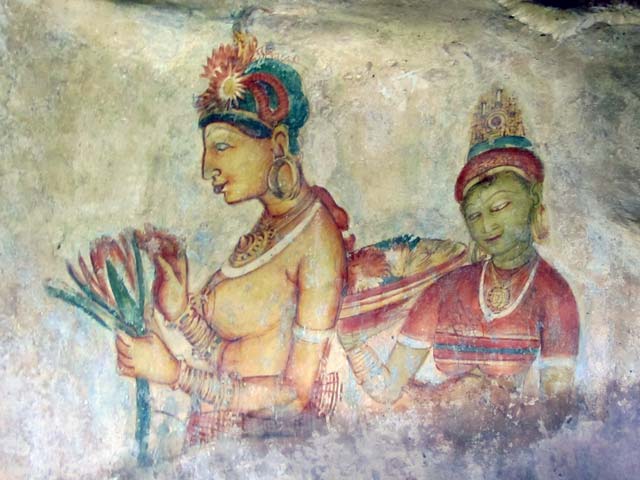
King Kasyapa didn't appear to be very religious. Instead he had a giant picture gallery created with 500 paintings of women like these. Only a handful are still visible today, but they have become iconic Sri Lankan images.


Our climb up Sigiriya was about one third the elevation gain of Sri Pada, and helped our legs to get over their soreness. We were happy that the steps were uniform and even height, and that the photo on the right was no longer the way to reach the summit!


Sigiriya was a monastery starting in the 3rd century B.C. and lasting until the 14th century. Here is Pete in between arched boulders, an interesting passageway on the way up to the peak.